Collected 1,410 student questions, built an LSA+KNN classification pipeline from scratch in PHP,
improved accuracy from 92.1% → 93.2%, reduced inference time by 35%, then deployed it as
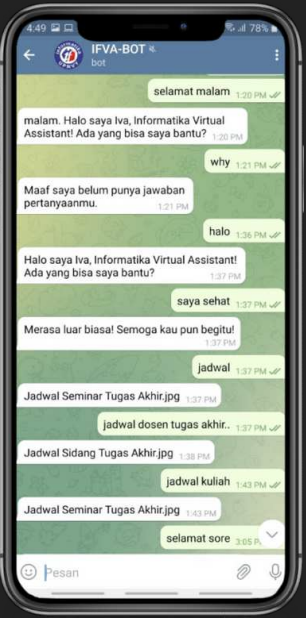
both a web application and Telegram bot.
Students kept asking the same questions. The department had no scalable answer.
The Informatics Department delivered information through circulars and manual replies — limited by office hours, answering the same questions repeatedly. A classification chatbot was the right solution.
Student Question
raw Indonesian text
↓
NLP Classification
LSA + KNN pipeline
↓
Topic Prediction
intent label
↓
Automated Reply
template answer from DB
Challenge
Repetitive student questions answered manually
Limited to office hours — no 24/7 self-service
Standard KNN fails on high-dimensional sparse vectors
Indonesian morphology breaks English NLP tools
Solution
NLP-powered FAQ chatbot for the department
Indonesian preprocessing (Nazief-Andriani stemmer)
Semantic classification using LSA + KNN
Impact
Accuracy ↑ 1.1 pp (92.1% → 93.2%)
Recall ↑ 3.0 pp
Inference time ↓ 35% (27.49s → 17.97s)
02 · Architecture
From raw text to semantic classification.
The pipeline solves two problems simultaneously: Indonesian morphology fragmentation, and the curse of dimensionality in KNN. LSA via SVD handles both.
KNN on raw TF-IDF has two structural problems: sparse high-dimensional vectors make distance computation slow and noisy, and lexical matching fails when students phrase the same question differently.
LSA fixes both: SVD reduces dimensionality (cutting noise and compute time), and the latent semantic space groups words that appear in similar contexts — so "daftar ulang" and "her" map to the same intent even if they never overlap in training data.
Indonesian NLP specifics
Bahasa Indonesia uses prefix, suffix, and circumfix morphology — the root "ajar" can appear as "mengajar", "pelajaran", "diajarkan", "pembelajaran". Treating each as a separate token fractures the vocabulary.
The Nazief-Andriani stemmer strips affixes according to Indonesian morphological rules, collapsing all surface forms back to their root. Without this, TF-IDF produces severely fragmented features.
03 · Experiment Design
KNN vs LSA + KNN. Why this experiment?
Every design choice has a reason. Here's the experimental setup and the logic behind each decision.
Dataset
1,410 Labelled Questions
collected via structured form · 20 intent categories
↓
Validation Method
10-Fold Cross Validation
90% train / 10% test per fold
↓
Baseline
KNN
TF-IDF sparse vectors
Manhattan distance
No dimensionality reduction
92.1% accuracy · 27.49s
Experiment
LSA + KNN
TF-IDF → SVD → LSA dense vectors
Manhattan distance (same classifier)
k=661 latent dimensions
93.2% accuracy · 17.97s ↑
Why KNN?
Simple, interpretable, requires no training iteration — appropriate for a labelled corpus where similarity in vector space maps directly to category membership. A strong baseline before adding LSA.
Why TF-IDF?
TF-IDF assigns higher weight to terms that are distinctive to a question but rare across the corpus — the right prior for intent classification where rare keywords carry the most signal.
Why LSA?
KNN on raw TF-IDF suffers from the curse of dimensionality. LSA via SVD compresses features into a dense semantic space, reducing noise and enabling synonym grouping — so the classifier doesn't need an exact vocabulary match.
Why 10-fold CV?
With 1,410 samples, 10-fold CV maximises the use of data for both training and evaluation while keeping each fold large enough for reliable metric estimates. Standard choice for this scale.
04 · Results
LSA improves every metric and cuts compute time by 35%.
Results across 10-fold cross-validation. The key finding: LSA does not just improve accuracy — it improves precision, recall, and AUC simultaneously, while making the model meaningfully faster.
KNN baseline
LSA + KNN
Accuracy
92.1%
93.2%
Precision
76.7%
78.8%
Recall
74.9%
77.9%
AUC
85%
87%
Compute time
27.49s
17.97s
Metric
KNN (baseline)
LSA + KNN
Change
Accuracy (avg)
92.1%
93.2%
+1.1pp
Precision (avg)
76.7%
78.8%
+2.1pp
Recall (avg)
74.9%
77.9%
+3.0pp
AUC (avg)
85%
87%
+2pp
Compute time
27.49s
17.97s
−35%
"LSA doesn't just improve accuracy — it makes the model faster by giving KNN less distance to compute over a denser, more meaningful space."
— Thesis conclusion, Aug 2021
05 · Product Delivery
Not a notebook. A working department chatbot.
Web application
PHPMySQLBootstrap 3jQuery
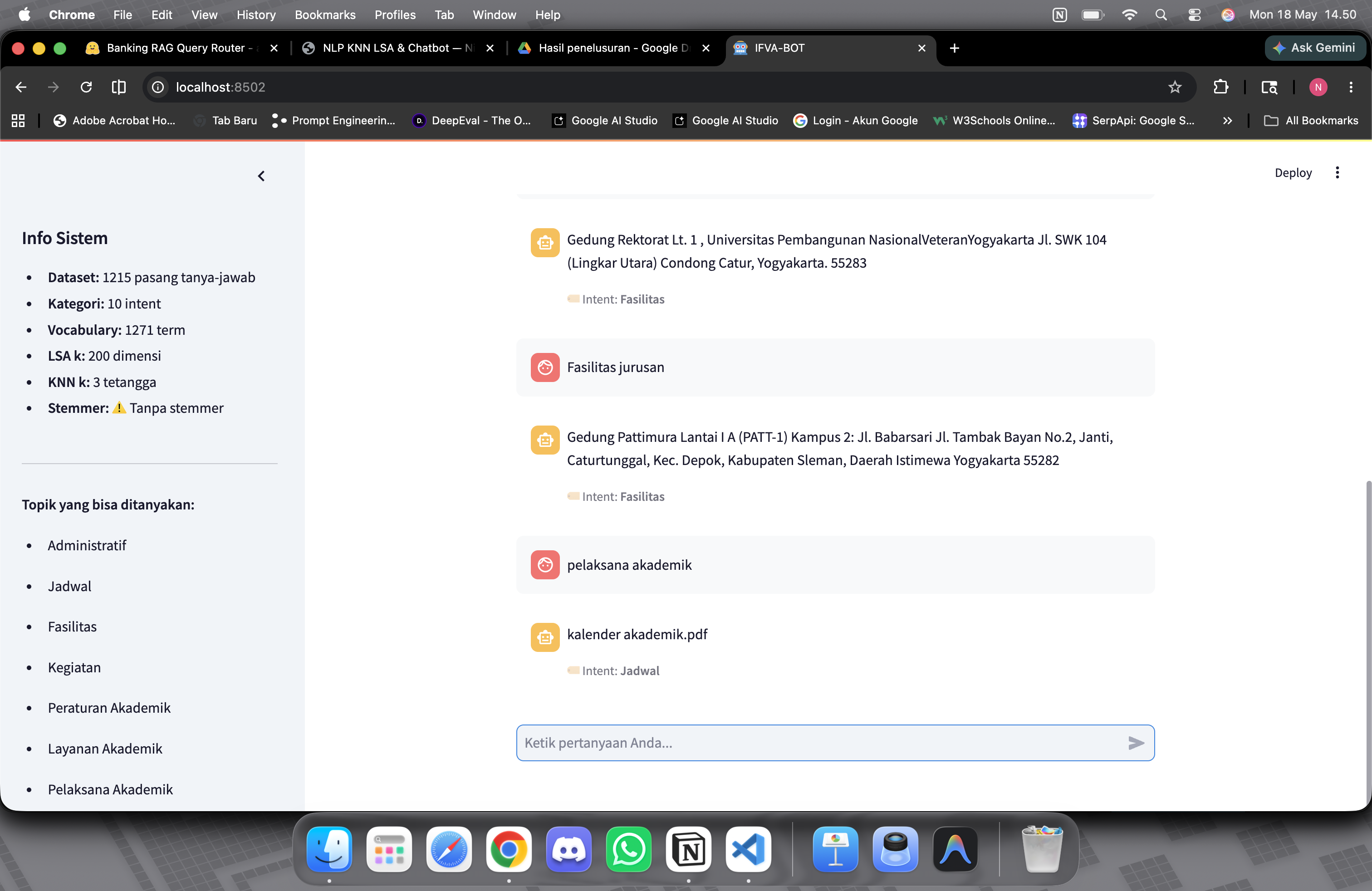
The web interface exposes the full pipeline interactively — users can see the raw input, the TF-IDF matrix, the SVD reduction, the LSA projection, and the final KNN classification result step by step.
Telegram bot
Telegram APIPHPWebhook
The same classification backend powers a Telegram bot, giving students a conversational interface to ask questions and get categorised answers at any time — without waiting for a staff reply.
Web app · pipeline classification step-by-step visible
Telegram bot · same backend, conversational interface
NLP stack
Rubix MLSastrawiNumPHP
Sastrawi provides the Nazief-Andriani Indonesian stemmer. Rubix ML handles the KNN classifier and TF-IDF vectorisation. SVD is implemented using custom PHP matrix operations — the 59 MB precomputed SVD matrix is stored as JSON for fast retrieval.
Model artifacts
JSONCSV.model files
Serialised models: knn.model (8.7 MB) and knn-lsa.model (18.5 MB). The precomputed SVD matrix (svd.json, 59 MB) is loaded at request time to avoid re-computing decomposition on each query.
06 · Technical Deep Dive
What I actually built, end to end.
→Expand 8-step implementation walkthrough
This was not just a model experiment. I went from collecting data via a form to a working chatbot deployed on the web and Telegram — implementing KNN and LSA from the mathematical level up in PHP.
Step 01 · Data Collection
Collect real questions from the department.
I gathered student questions from the Informatics Department of UPN "Veteran" Yogyakarta using a structured form. Each question was manually labelled by topic category.
1,410 questions across multiple intent categories
Labels: per topic (academic, registration, facilities, etc.)
Step 02 · Text Preprocessing
Clean and normalise Indonesian text.
Raw questions go through a 6-stage pipeline before any ML is applied. Indonesian has complex morphology — stemming here requires a purpose-built Indonesian algorithm.
Case folding → remove punctuation → remove numbers
Tokenising → stopword removal (custom ID list)
Stemming: Nazief-Andriani algorithm for Bahasa Indonesia
Step 03 · TF-IDF Feature Extraction
Turn words into weighted vectors.
Each preprocessed question is encoded as a TF-IDF vector over the full vocabulary. This creates a high-dimensional, sparse feature matrix — the problem KNN struggles with.
Term Frequency × Inverse Document Frequency weighting
Reduce dimensions via Singular Value Decomposition.
The TF-IDF matrix is decomposed using SVD. I implemented the SVD matrix operations directly in PHP using custom numerical computation. The top-k singular values are retained.
SVD: A = U × Σ × Vᵀ
Precomputed SVD matrix: 59MB stored as JSON
Step 05 · LSA Feature Selection
Map questions into a dense semantic space.
LSA uses the reduced SVD representations to project questions into a latent semantic space, capturing relationships between words that co-occur in similar contexts.
Cosine similarity in reduced space (k=661 dimensions)
Connects semantically similar questions even with different words
Step 06 · KNN Training
Train the classifier on LSA-reduced features.
K-Nearest Neighbors is trained on the LSA-projected feature vectors. Distance is computed using Manhattan distance. The model is serialised to disk for serving.
Evaluate rigorously with 10-fold cross-validation.
Both KNN and LSA+KNN are evaluated on all 10 folds. Accuracy, precision, recall, and AUC are compared — not just accuracy.
10-fold CV: 90% train / 10% test per fold
Metrics: accuracy, precision, recall, F-beta, AUC
Step 08 · Web App + Telegram Bot
Deploy as a working product.
The trained model is integrated into a PHP web application that visualises the full pipeline step by step, and a Telegram bot for real conversational access.
Web: PHP + MySQL + Bootstrap 3
Telegram bot: connected to same classification backend
Steps 1–2 of 8
07 · Lessons Learned
Three things I still carry from this thesis.
01 · Feature Engineering
Feature engineering > model complexity
The classifier didn't change — KNN is KNN. What changed was the feature space. LSA gave KNN better geometry to work with: denser, lower-dimensional, semantically coherent. Fix your representation before tuning hyperparameters.
02 · Language
Language matters
Applying an English pipeline to Bahasa Indonesia would have produced a fractured vocabulary and degraded every downstream metric. Indonesian stemming significantly reduced vocabulary fragmentation. Language-specific preprocessing is non-negotiable.
03 · Deployment
Research ≠ product
The thesis passed. But wiring the model to a MySQL database and exposing it through a Telegram bot taught me things no experiment could: serialisation, request handling, and what "accuracy" means when a real user gets a wrong answer.
"Accuracy improved 1.1 pp. Compute time dropped 35%. But the real result was learning to take a research paper all the way to a deployed chatbot."
— Ninditya Salma Nur Aini, 2021
University of Amsterdam thesis evaluating Indonesian stemming algorithms including Nazief-Andriani. Primary reference for Indonesian morphological normalisation.
IJCAI paper establishing k-fold cross-validation as the standard for model evaluation. Grounds the 10-fold CV methodology.
Try the demo · Read the thesis · See the code
Live demo on Streamlit. Full source on GitHub.
The complete thesis (110+ pages, in Indonesian) covers the full mathematical derivation of SVD and LSA, the dataset collection methodology, and all 10-fold evaluation results. The source code includes the PHP web interface, all NLP pipeline stages, and the Telegram bot integration.